

-23.png?w=1376&h=768)
Three Types of Reading Glasses
The three core types of reading glasses commonly referred to are single-vision lenses, bifocal lenses, and progressive multifocal lenses, which differ significantly in focal design, applicable scenarios, price, and adaptation difficulty.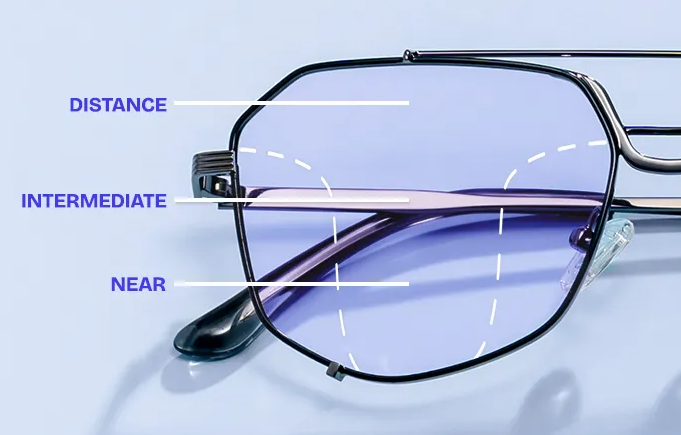
1. Single-vision Reading Glasses (Single-focus)
- Core Design: The entire lens has a fixed power, only suitable for close-up activities such as reading or using a phone at around 33 cm; you must take them off or switch glasses for distance vision.
- Advantages: Low price, stable optics, and almost no adaptation period, suitable for people who only need to focus on close-up tasks for long periods.
- Disadvantages: Cannot cover medium or distance vision, requiring frequent removal and replacement.
2. Bifocal Reading Glasses (Bifocal)
- Core Design: The lens is divided into upper and lower sections; the upper section is for distance vision (plano or myopia power), and the lower section is for close-up vision. There is a visible dividing line in the middle with no transitional zone for medium distances, causing a "jump" effect when switching.
- Advantages: One pair of glasses for both distance and close-up vision, lower cost than progressive lenses, suitable for those on a budget who need frequent switching between distance and close-up.
- Disadvantages: Unattractive appearance with a dividing line, blurred vision for medium distances (e.g., computer screens), and some people find the jump effect difficult to adapt to.
3. Progressive Multifocal Reading Glasses
- Core Design: The lens power gradually changes smoothly from top to bottom, with no dividing line, covering the full range of vision for distance, medium (computer), and close-up (reading) in one lens; the appearance is the same as regular glasses.
- Advantages: The strongest scene compatibility, all-purpose for driving, working, and using a phone, with high aesthetics.
- Disadvantages: Highest price, slight peripheral distortion, requiring a 1–2 week adaptation period, and high demands on optometry and lens precision (must be fitted by a professional institution).
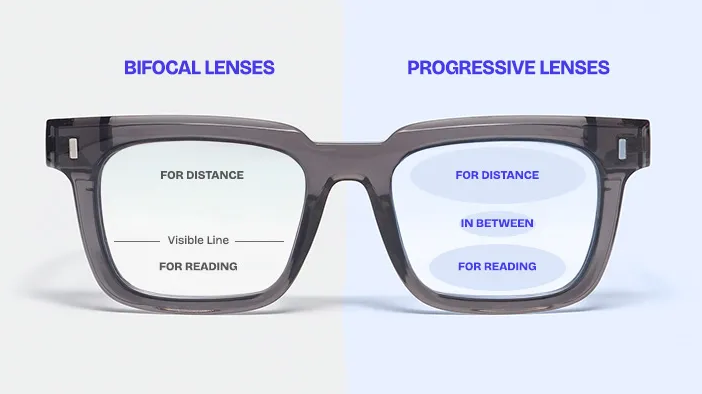
Feature Single-vision Lenses Bifocal Lenses Progressive Multifocal Lenses Applicable Distance Only close-up Distance + close-up (no middle) Full range: distance, medium, close-up Appearance Simple Obvious dividing line No dividing line, same as regular glasses Price Low Medium High Adaptation Difficulty Almost none Medium (jump effect) Higher (peripheral distortion) Best For People who only need reading Budget-conscious, frequent distance/close-up switching Multi-scenario users, aesthetic focus


-42.jpg?w=2048&h=2048)
.png?w=2048&h=2048)



.jpg?w=4096&h=4096)
-2.png?w=2048&h=2048)
-1.png?w=2048&h=2048)

-3.png?w=2048&h=2048)
-4.png?w=2048&h=2048)